Thursday, January 19, 2017

Mystifying Maneuver: Sally Forth

Good afternoon, cannon fodders. Today we tackle Sally Forth.

Over the years, I have been asked about this maneuver enough times to have a standard response. There are a lot of muggle myths surrounding Sally Forth, probably because it is a PvP-only maneuver that is rarely used by anyone. We will discuss the actual game mechanics of Sally Forth, and then examine a rare battle report that shows its correct usage in actual warfare.

A Rarely Used Tool


Sally Forth is a tool in the PvP toolbox. It is a highly specialized delay tactic. I cannot sufficiently emphasize the "highly" part. I doubt that less than 1% of the entire Illyriad player base has ever even seen a situation where a Sally Forth made good tactical sense. With that disclaimer, the maneuver works in the following way:

  • All armies and reinforcements in the city will attack a siege camp together.
  • The maneuver is a Raid, not an attack. It cannot destroy the siege camp.
  • A successful Sally Forth will stun the siege for 4 hours.
  • Stunned sieges will fire again in 4 hours from impact (the bombardment time changes).
  • The Sally Forth maneuver can be attempted once every 6 hours.

The important thing to understand is that Sally Forth is a delay tactic. The strategy has several major risks and downsides:

  • By definition, the Raid cannot break a siege on its own. The best it can do is destroy 33% of the siege camp, and pause the siege for 4 hours.
  • Reinforcements cannot dodge.
  • Reinforcement owners receive no warning of incoming enemy attacks.
  • Placing attack units as reinforcements in a damaged city means they can be forced to defend by attacking enemy units. This is especially bad if enemy battering rams have damaged or destroyed the wall. Attack units like cavalry and infantry tend to defend very poorly.
  • Any defensive reinforcements in the city will also be forced to attack the siege camp. Dragging spear units into an attack can be a very costly proposition, especially if the siege camp includes bows (which it almost certainly will).

Due to these downsides, players almost always elect to strike the siege camp directly with terrain-appropriate attack units. That will actually break a siege, rather than lightly damage and pause it. Keep in mind that if the internal armies had enough attack power to stun the siege with a successful Sally Forth, then by definition they had the power to completely destroy the siege if sent directly at the camp. Why stun a siege when you could have broken it completely? Good question.

When to Sally Forth


The answer can be complicated, but the decision to Sally Forth boils down to a few factors.

  • You know that enough breaking power is already on the way from your allies. If there isn't enough power on the way, then delaying the siege bombardments is just delaying the inevitable.
  • The breaking power will take a long time to arrive. Most likely because it's infantry breaking a non-plains siege camp on a forest or building tile.
  • You want to conserve troops in the local area.
  • You have enough local breaking power to destroy the siege, but it's the wrong kind of troop type, leading to a very inefficient kill ratio.

Does that actually happen? In theory, sure. In practice, almost never. I have personally used the Sally Forth maneuver twice in three years of warfare, as part of the two most PvP-oriented alliances in the game. The first time was an experiment against my students in Night Squires. Which means I have used this maneuver precisely once in actual warfare. I can count on one hand the times I have seen a real battle report generated from a Sally Forth during genuine city-to-city combat.

The Unbowed vs. Aryaelf [SIN]


So here it is, the actual use of Sally Forth in battle. Ayraelf was an elven player in The Hashashin [SIN]. She was very fond of putting cities in forests because the spear and bow sovereignty was so much higher than an ordinary city. During the Unbow-SIN war, Ayraelf was less active, so when the siege camps inevitably got launched at her cities, I was appointed as her sitter to keep things alive. You can read all about the sieges in these Illyriad Times articles:


The fourth article listed contains my comments on the siege and resulting battles. For whatever reason, SHARK-VIC chose to split their siege camps into an all-bow camp on a lake, and an all-spear camp in a large forest. I knew that Ayraelf's cities were likely to be targeted again because several of them were vulnerable, so I did not want to burn all her remaining troops in nearby towns. The attackers that I had available to strike the large forest were: t2 swords (great), t2 cavalry (lame for terrain, terrible against the defenders), and t1/t2 bows (terrible for large forest, good against the defense). The spear defenders were vulnerable to the sword and bow attackers. I already knew that the SIN dwarves--Tink XX (now Tinkinator), Goldy1, OleBlackLord--had sent enough stalwarts to break the siege, but it was going to take them almost a day to converge on the siege camps. These conditions made it desirable to stun the siege multiple times, to conserve Ayraelf's sub-optimal troops until the dwarven stalwarts could break the siege.

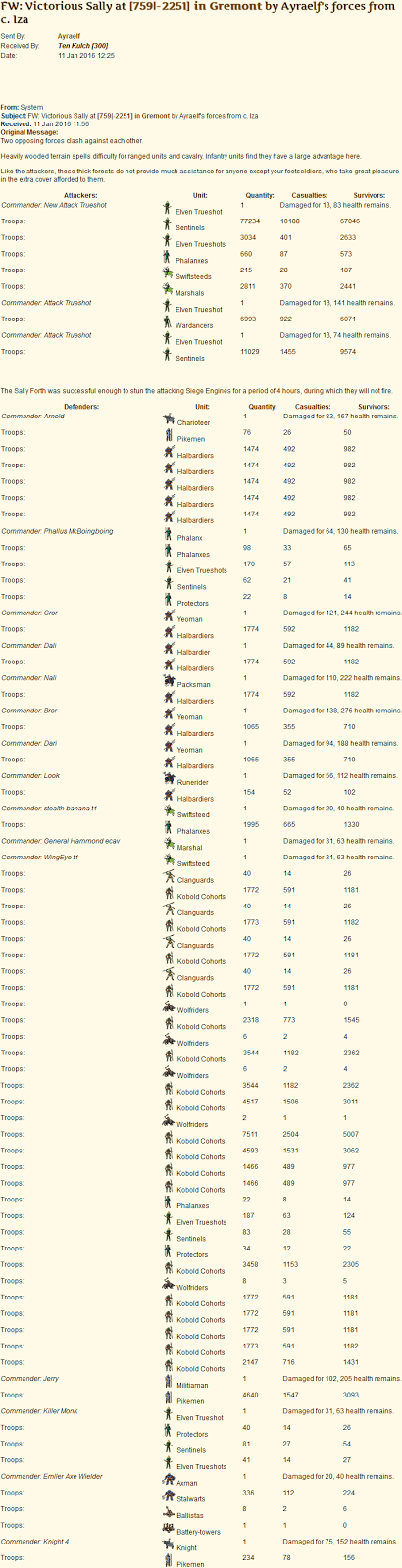
As you read the report, I have never really understood the damage allocation to commanders. It seems that some commanders suffered more than 100 points of damage. I don't know if that is a display error, or if that really happens during a Sally Forth maneuver. It is also unusual that commanders suffered varying amounts of damage; usually in a camp everyone takes the same proportional losses and identical commander damage.

You can see that the armies suffered casualties like a Raid, with the defensive losers having 33% of their armies destroyed. Because the first Sally Forth killed the enemy cotters scavenging equipment, Ayraelf received a Gathering Units Destroyed battle report. The result still functioned normally, stunning the siege for 4 hours. You can see the text below the attackers, "The Sally Forth was successful enough to stun the attacking Siege Engines for a period of 4 hours, during which they will not fire." The second report shows a Victorious Sally using the troops from three different cities to stun the siege again. Over time, the friendly stalwart armies began to arrive and rip those enemy spears to pieces.


The second battle report:


Okay, cannon fodders. You should have learned what the Sally Forth maneuver does, and when to use it.

Misbehave. Kill lots of Stuff.

<^^^^^^^^||==O    Skint Jagblade

Wednesday, January 18, 2017

The Jagblade Guide to Equipment

Good afternoon, cannon fodders. Today we tackle one of the most confusing subjects in Illyriad: crafted items. You can find the complete table on my profile. Illyriad has embedded code widgets for crafted items, so rather than replicate that functionality on an external site (like the defunct Illy Crafting), I have elected to use the in-game code infrastructure directly.

Why does specialized gear mystify the muggles?  One issue is scale. There are almost 200 crafted items in Illyriad, but less than 20 are actually useful for player-vs-player combat. Another is that most players lack familiarity with PvP units and terrain interactions, so the proper choices are not entirely apparent. Finally, as with all useful things in Illyriad, there are a variety of well-intentioned but completely foolish muggle myths surrounding crafted equipment. If you have taken crafting advice from anyone who is not an expert PvP combatant, then you have probably been given a mix of acceptable advice and utter uselessness. That is even true if the advice came from the self-professed crafters and crafting alliances of Illyriad. As with self-professed traders and warriors in this game, very few of those people actually possess a basic competence in the game mechanics of their untested "expertise". Take their advice at your own risk.

It's About the Kills

Specialized gear is meant to amplify the destructive abilities of troops. In general, what you really want to do is take the correct unit for a particular battle, and heavily multiply its desired stats for that battle. Ideally, you are looking for equipment that:

  • Is used for city defense.
  • Amplifies the proper defenders against expected attack types.
  • Can be manufactured in bulk quantities, to equip entire armies.

Why city defense?

Defenders behind a city wall have a 100% equipment drop rate. Attackers and field defenders have a 10-20% drop rate. If you send gear into the field, assume it will be destroyed. Even if the gear isn't destroyed, assume your enemies will recover everything you dropped.

Proper defenders? Expected attack types?

It all goes back to the One Chart to Rule Them All. 

Let's take an example. You have a city on a forest tile (probably surrounded by plains, because you've taken my city placement advice). Referencing the chart, we see that the most likely direct attack against that city is t2 sword units, probably dwarven stalwarts. Consulting the chart again, the best two infantry defenders in a forest are kobolds and fangs. Therefore, what you really want is a set of items to boost the sword defense or the forest performance of kobolds and fangs.

Kobold: battle spear, trident, splintmail, forester spear, forester leather, (highland armor*)
Fang: longsword, thick-ring chainmail, short sword, woodsman chainmail

 
Bulk quantities?

That list seems easy enough, right? Unfortunately, you cannot actually obtain most of those items in quantities greater than 10000 at any reasonable price. Not all magical materials are available in the same quantities, and that severely limits the usefulness of particular items for PvP.

In our example above, the jaguar fur required to make battle spears and longswords just isn't that plentiful. The entire posted supply in Centrum is enough to make about 4000 anti-sword weapons. Jaguars only seem to appear in small groups, so the harvested supply is quite modest. Now compare that to the trident, which is manufactured using very abundant Ancient Oak and Iceheart, two of the most common materials in the entire game. You can easily secure enough materials to make spears for a decent defense force of 25000-50000 kobolds. There are hundreds of Ancient Oak patches, and both polar regions are full of Iceheart mines. The forest spear and short sword (forest sword) are both green rated for the same reason, because Giant Rat Fur is abundant. The forest armors get a yellow rating because they depend on scaled charger scales, which are rare compared to the demand, and therefore prohibitively expensive. The thick-ring chainmail depends on Arterium, which is a rare, expensive, and highly controlled material. The few big Arterium mines on the map are jealously guarded. This situation renders thick-ring chainmail worthless as a viable defense option.

The most glaring example of rarity is elemental salts. Each daily spawn will result in a tiny handful of salts. Items built with elemental salts can have very powerful stats, but at 100000 per salt, how can it ever be worth equipping a 1000 gold unit? You will be much better off finding an effective substitute and purchasing 10x as many of that item. Even the mighty Silversteel Chainmail is only +75%, where terrain armor is one-tenth the cost and provides +60%.

The Bottom Line

Since there are 17 green items and 15 yellow items, we may as well just discuss their merits individually. These are my personal opinions, but all opinions are not equal. I have done a lot of city-to-city fighting, and these crafted items have emerged as the best arsenal for a serious PvP player. When you read these descriptions, I want you to always keep in mind that you can have a portfolio of gear. Every division in an army can equip a different gear mix. You can layer a lot of different combinations, but I have found that simplicity is generally the best option in the heat of battle.

The Common Touch

Probably 85% of cities in Illyriad are plains cities, with another 10% jungle forest cities. Cavalry and infantry are the most common attack units. So your goal is stopping the two most common attackers against the two most common city terrains. Plains, forest, anti-cavalry, anti-infantry. If you don't have any forest cities, and neither does anyone else in your alliance, then you can safely ignore the forest gear.

Plains spears can be used to equip kobolds and non-dwarf t2 spear units. Plains leather can also be used to equip bow units. As an added bonus, plains leather is +100% for humans on plains (+60% plains, +40% humans). Plains bows get a yellow rating because the require scaled charger vertebrae that are better invested in plains spears. Using two plains items will give you a 2x +60% bonus in your plains city. That's great because it covers both infantry and cavalry.

By far the most common attacker against plains cities is cavalry. Pikes are always in high demand for kobolds and t2 spears. Beware of reinforced leather, it is nerfed gear and nearly worthless (+24%). That's why kobolds get plains leather. For stopping cavalry attacks, the best option is reinforced chainmail (+80%), which can be equipped by all t2 spears. The 2x +80% defense vs. cavalry is extremely potent when combined with the high cavalry defense of t2 spears, and can be worth the extra investment.

For stopping infantry, the preferred items are tridents (+60% vs infantry) and splintmail (+120% vs infantry). It is excruciating for stalwarts to smack into kobolds behind a wall in splintmail and tridents. The nice aspect of these defense-focused items is that they work equally on all terrains. If you have a mix of plains and forest cities, this might be a great defense option for you. Non-orcs can equip t2 spears, although dwarf halbardiers cannot equip splintmail. The high-power bow is also a great option, but the quantities of brown bear fur are limited.

As stated above, if you don't have any forest cities, and neither does anyone else in your alliance, then you can safely ignore the forest gear. If you do have forest cities, they can be defended effectively with forest spears and short swords. The best option is probably kobolds with forest spears, and some mix of splintmail (to stop infantry), forest leather (yellow due to scaled charger scales), and highland armor (+20% forest, +40% orc, green rating due to abundant giant beetle carapace).

The Less Common Situations

If you have hill or mountain cities, then you should invest in hill or mountain gear. Per the chart, some of it is broadly available at good prices. Much of it is not. In my personal experience, almost all competent enemies will avoid your entrenched cities like the plague, preferring to attack your plains cities instead.

At the alliance level, it's a good idea to have at least a little bow protection. Marksman bows and cloth-backed leather will turn any bow unit into an anti-bow monster. If you are fighting elves especially, having a 5000-10000 set of these items can make your life a lot easier.

Desert leather and chainmail are mentioned as yellow options. For desert fighters, these armors can be made using inexpensive and very common components. They are a good option to round out a defensive set.

The Need for Speed

Sometimes you just need to move fast. Any siege armies will reqiure draught horses for the catapults and possibly rams. Riding horses can allow you to get city defenders into position more easily, to intercept faster enemy attackers. Elven swiftsteeds will tear across the map with light spears, extra light leather, and elven thoroughbreds. Orcs can replicate that with light spears, extra light leather, war wolves, although at 5 hides the war wolf option is considerably more expensive.

Hit Me with Your Best Shot

If you are attacking with t1 cavalry, particularly elite divisions, then vanguard leather can be cost effective. Just be aware that it's a one-shot weapon. The same is true of plainsman platemail equipped to attacking t2 cavalry on plains, or short swords for t2 infantry in forests. There are times when you just need a harder hit with your remaining troops, and it's good to have that option. It is unfortunate that the War Axe depends on Arterium, because it backs a fantastic all-purpose punch for dwarven stalwarts.

The Trash Heap

So what's left? There are three broad categories of trash: defense boosts to a poor defender, obscure component materials, and items that didn't receive the 5x power update.

I will say the most about mismatched items. Examples: Infantry sucks at bow defense, so there is no point to having the battle sword (+60% bow defense to infantry units). Nobody attacks with spears, so what are you going to do with hardened leather (+120% spear defense)? Nothing. You know who uses bows to defend cavalry attacks with long-draw bows (+80% cavalry defense)? Nobody. Bows suck at cavalry defense. The wolf furs would be much better invested into pikes.

Rare materials can produce some powerful weapons. At 100000 a pop, these items are much better suited to commander gear than equipping entire armies. I will say that Silversteel is the biggest scam in the game. Don't get conned. Terrain items are better for attacking, and can be purchased 10:1 for city defense. Anything with a blue rating is guaranteed to be cost-ineffective for equipping reasonable armies.

Red rated items are now obselete. A few years ago, the devs gave a 5x bonus boost (and 2x penalty boost) to all items that use a rare material. Their definition of "rare" did not include basic hides, minerals, or herbs. Items that lacked a rare component did not receive updated stats. In many cases this has created holes in the equipment chart. Racial swords are notably worthless.

Go Forth and Stab Each Other

Now you know my reasoning process for sorting crafted items into green, yellow, white, red, blue. Go forth, cannon fodders, and dispel the muggle myths about equipment!

Misbehave. Kill lots of stuff.

<^^^^^^^^||==O    Skint Jagblade


Tuesday, January 10, 2017

One Chart to Rule Them All

Greetings, cannon fodders!

Today it is time to combine two of my favorite topics: maffs and killing stuff. I know you can hardly contain your joy, but wait, there's more! CHARTS. I know, right? Best article ever.

Oh Noes, Maffs!


Don't worry, I'm going to explain everything. I know that many of you cringe at the thought of charts, graphs, killing stuff, and maffs. I will talk through the numbers and highlight some of the most important concepts. Before I get into that, let's just step back for a moment and consider PvP as a whole in Illyriad. PvP in this game is primarily about armies. There are three basic things that concern military players about armies: 

  • How fast can points be built?
  • How much does it cost to build those points?
  • How much does it cost to hold those points?

During a war or tournament, you care mostly about how quickly you can build points. You want to field the right army for the job with the most points possible in the required categories. A secondary concern is how much those points cost to build. Most military players don't really emphasize the point cost, because when someone is trying to kill your cities, you get really focused on stopping them.  It's only during slow times that you start to get interested in gold upkeep per point, because big armies will burn a whole lot of gold when you are holding them indefinitely.

You will notice that I didn't mention the unit stats anywhere. That's because points are relative. It's crucial to understand that. Some units have high stats, but they take a long time to build or cost a lot of gold to keep. The classic example is t2 cavalry. Powerful, slow to build, expensive to maintain. Other units might have low stats but build very quickly. Kobolds are the best example of cheap and fast. Kobolds will allow you to very quickly generate an army that defends well against infantry and cavalry. What I want you to remember is that you don't really care about the individual unit stats. You care about the army that is built out of their points. The only way to make an apples-to-apples comparison is to evaluate the unit stats in the context of terrain, build time, upkeep, and build cost.

The Maffs of Fast


Today we are going to talk about producing points quickly. You care about rapid point production during a war or tournament, when the fighting is heavy. The goal of high speed production is to produce the most points for a specific job--attacking, cavalry defense, bow defense, sword defense, or some combination of those four--in the shortest timeframe possible. As with all things military, we give proper consideration to how the army will perform on various terrains that we expect to encounter in a war or tournament, and to the various enemy armies that we might reasonably expect to fight.

The metric we will use is Points Per Hour (PPH). The columns tell us how many points a particular unit will contribute to your army, for a particular terrain, in each of the five stat categories (attack, spear defense, bow defense, sword defense, cavalry defense). The numbers in this chart are based on a level 20 Barracks with no sovereignty.

First I present the giant chart of everything. Huge, right? Probably makes your eyes sting a little. This chart is meant to make your vision glaze over, and all maffs-hating muggle hearts clench in fear. That way when you get to my highly simplified chart at the end, it will seem like I have given you some kind of magical gift that allows you to speak PvP without actually grinding out all the maffs yourself.

Red means the stat sucks. Gray, blah. Yellow is pretty good. Green is excellent.

Remember, the point of the chart is to compare various armies. In every battle, there is an attacker, a defender, and a terrain. All battles are relative. Smashing a gray attacker into a red defender can be way more effective than a green vs. green battle where nobody has an advantage.


A Giant Soul-Crushing Chart


Figure 1: Colors! Maffs! Blindness!

Ok, so what does this chart actually tell us?

Nobody attacks with spears.

All the t1 spears are red for attack except kobolds. All the t2 spears are low gray for attack. So right away, the attack side of the equation is poor. Now notice that there are a whole lot of units that have yellow and green spear defense. Banging a red/gray attacker into a yellow/green defender is going to make you very sorry. That's why nobody attacks with spears.

Spears have terrible bow defense.

Agony is a small army of elven sentinels tearing through a huge army of kobolds. All credible PvP maneuvers will include some defending bow units to cover your spears. Otherwise you are wide open to a world of PvP pain.

Bows defend better than they attack.

Bows defend against bows 1.5x better than they attack.

Infantry is a flexible attacker.

t2 infantry is the best attacker on all terrains except plains.

Nothing beats attacking cavalry on plains.

Cavalry is an attack unit that has a single purpose: to hit like a sledgehammer on plains. They're handy on small hills as well. This is why my City Placement Rule #2 is surround your cities by plains.

Cavalry sucks at defense.

Cavalry is an attack unit that has a single purpose: to hit like a sledgehammer on plains. If you are using them for any defensive purpose, expect a whole lot of disappointment. If you send them to attack non-plains tiles, expect a whole lot of disappointment. Look at how much smaller that attack number gets when you send them anywhere but plains.

Most unit types are equivalent across the races.

The vast majority of units are comparable across the races. A t2 spear is a t2 spear for everyone. The exceptions are the special racial units you might expect: orc spears, elven bows, dwarven infantry, human cavalry. The one exception that most people don't expect is orc fangs.

t2 spears are superior to t1 spears for production.

t2 infantry is superior to t1 infantry for production.

t1 bows are mostly equivalent to t2 bows for production.


This one surprises a lot of people.

t2 cavalry is superior to t1 cavalry for production, BUT...

The whole point of t1 cavalry is that it is fast. There are times when moving at 150% of t2 cavalry speeds is much more important than bringing the extra attack power. For example, when your city is being ripped down around your ears by enemy siege engines. You did remember to surround by plains, right?

A Much Easier Chart


Figure 2: The short short version.


For this chart, I created typical units by averaging similar racial units together. When you are maximizing production, there is almost no point to producing t2 bows, t1 infantry, or non-orc t1 spears. However, before you dismiss those units as worthless, many of them have advantages in build cost per point and upkeep per point.

Elven marshals are the best cavalry in the game.

Elven marshals get the 150% speed advantage of t1 cavalry, and strike with the full power of t2 cavalry. In fact, they are 90% as powerful as knights. So surprise, the human's special racial unit isn't nearly as powerful as you thought.

Sentinels are just as good as trueshots.

For production, sentinels are just as good as trueshots. This will seem particularly unjust when I tell you that as the best bow unit in the game, sentinels are also modest on upkeep, and are the single cheapest unit to build. As an added bonus, they also attack other race's defending bows as 1:1. No attack disadvantage for these guys!

t2 infantry is the best attacker on all terrains except plains.

Ever since the infantry update, these units have become powerful universal attackers.

t2 infantry beats bows on all terrains.

This is especially important, because bows are really the only effective defense against infantry. In the worst case scenarios, infantry still holds a 3:2 point generation advantage in a battle with defending bows.

Most spear units are lame at infantry defense.

Really lame. Even t2 spears have cringeworthy infantry defense. Kobolds are the only exception.

Stalwarts and fangs are particularly vicious.

Look at those attack points! Everyone knows that dwarven stalwarts are deadly attackers, but did you know that fangs are a close second? Fangs are actually superior to other races' t2 sword units. Added bonus, fangs are also tough infantry defenders and have adequate cavalry defense. If that seems unfair, wait until the upkeep discussion. Unlike the Mary Sue sentinels, who have no real downside, the per-point upkeep on fangs will make your eyes bleed.

Infantry is only adequate at defending buildings and forests.

Like cavalry, your infantry is an attack unit. Using it to defend will lead to a hefty tavern bill and a lot of dead infantry. There is a persistent myth that infanty excels at defending buildings and forest. In reality, those tiles will apply a big terrain bonus to a fairly lame base defense score. The result is underwhelming. The only real exception are defending fangs, and they will still lose the PPH battle 4:3 against any t2 sword attackers.

Kobolds are little monsters.

Be warned: kobolds can make you feel invincible. These cheap little buggers will quickly fill out an army. Sitting on a million kobolds can inspire overconfidence, until you realize just how rapidly they die during combat. Even so, they are the best cannon fodder in the game. Kobolds are the only unit aside from fangs and bows that provides a good infantry defense. Their cavalry defense is superior to other race's t2 spears. Kobolds are hilariously cheap, second only to sentinels, but their upkeep can rapidly spiral out of control. Once war starts, the main objective for many orc military players is to get their kobolds killed before they bankrupt the treasury.

The backbone of any proper siege camp is kobolds and sentinels.

You know what's better than one overpowered unit? Combining them on a team! There is a reason why the orc-elf combo is so popular on the battlefield. Kobolds and sentinels cover each other's weaknesses and reinforce each other's strengths. The only certain way to defeat them is through the raw power of cavalry attacking on plains. Mathematically the only other scenario is t2 infantry, which has the enormous strategic disadvantage of slow speeds.


Conclusion


Ok, cannon fodders, what have we learned today?

  • Nobody attacks with spears.
  • Spears have terrible bow defense.
  • Bows defend better than they attack.
  • Infantry is a flexible attacker.
  • Nothing beats attacking cavalry on plains.
  • Cavalry sucks at defense.
  • Most unit types are equivalent across the races.
  • t2 spears are superior to t1 spears for production.
  • t2 infantry is superior to t1 infantry for production.
  • t1 bows are mostly equivalent to t2 bows for production.
  • t2 cavalry is superior to t1 cavalry for production, BUT...

Also...

  • Elven marshals are the best cavalry in the game.
  • Sentinels are just as good as trueshots.
  • t2 infantry is the best attacker on all terrains except plains.
  • t2 infantry beats bows on all terrains.
  • Most spear units are lame at infantry defense.
  • Stalwarts and fangs are particularly vicious.
  • Infantry is only adequate at defending buildings and forests.
  • Kobolds are little monsters.
  • The backbone of any proper siege camp is kobolds and sentinels.

 
Misbehave. Kill lots of stuff.

<^^^^^^^^||==O    Skint Jagblade

Tuesday, December 27, 2016

New Moon: Phase 1 Training

Congratulations Thunderdome students, for completing the first full moon PvP cycle. You have now been hacking away at each other for almost two weeks. At this point, you are certainly starting to realize the difference between theoretical knowledge (represented by casual discussion, GC, the forums) and the realities of Illyriad combat. That's good! You have taken your first steps into a larger world.

Now the new moon has risen, and rationality overtakes chaos. Our first true training phase will be split into two activities: timing exercises and army knowledge. All the Phase 1 timing exercises will be done with caravans, so that everyone can participate. No excuses. Army knowledge will be measured via written test. You will complete the questions and send me the answers privately in Slack.

Army Knowledge Questions


Day One
  1. How many living commanders can you have in a single city?
  2. How many dead commanders can you have in a single city?
  3. What is the single most important commander skill?
  4. What is your favorite commander skill?
  5. Which types of commanders are used for PvP army defense?
  6. Which types of commanders are used for PvP army attack?
  7. How many armies can you build in a single city?
Day Three
  1. What do we regard as defense units in Illyriad?
  2. What do we regard as attack units in Illyriad?
  3. Which terrain(s) most favor infantry? bows? spears? cavalry?
  4. What is the bonus from a level 20 wall?
  5. Why is the "surround by plains" method of city placement so popular?
Day Five
  1. Under what conditions do you attack with cavalry in Illyriad?
  2. Under what conditions do you defend with cavalry in Illyriad?
  3. Under what conditions do you attack with infantry in Illyriad?
  4. Under what conditions do you defend with infantry in Illyriad?
  5. Under what conditions do you attack with bows in Illyriad?
  6. Under what conditions do you defend with bows in Illyriad?
  7. Under what conditions do you attack with spears in Illyriad?
  8. Under what conditions do you defend with spears in Illyriad?
Day Seven
  1. If you had to suffer a cavalry attack, what units would you choose to defend, and on what terrain?
  2. If you had to suffer an infantry attack, what units would you choose to defend, and on what terrain?
  3. If you had to suffer a bow attack, what units would you choose to defend, and on what terrain?
  4. If you had to suffer a spear attack, what units would you choose to defend, and on what terrain?
  5. If you didn't know what would attack, what units (or unit mix) would you choose to defend, and on what terrain?
Day Nine
  1. How many troops will be blown up by the standard Ward of Destruction?
  2. What building reduces the upkeep cost of infantry? bows? spears? cavalry?
  3. How many military buildings are common in a military city?
  4. What is the point of military sovereignty?
  5. What is considered the typical military sov layout on a military city?
  6. How much faster will a level 20 barracks build troops than a level 1 barracks?
Day Eleven
  1. Which troop types are commonly regarded as the best for each race?
  2. Are there any other troops for each race that you regard highly?
  3. What unit(s) are the most flexible, efficient attackers in Illyriad?
  4. Are t2 units always superior to t1 units? Explain your answer.
  5. What is the difference between Points Per Upkeep (PPU) and Points Per Hour (PPH)?
  6. Why do we prefer PPU/PPH when comparing categories of units?
  7. When is Points Per Upkeep most important?
  8. When is Points Per Hour most important?
Day Thirteen

You may change your answers to any of the above questions, reflecting your improved knowledge of the subject.


Sunday, December 18, 2016

Commanders: Vitality, Healing, Defy Death

A cannon fodder in the Thunderdome training program asks:
Is there any reason to raise vitality on commanders when their damage is a percentage of troop casualty?

The short answer: my defensive PvP commanders have 3 levels of Vitality and Healing. I don't bother with much for my attack PvP commanders.

The long answer:

In a standard battle, the victor takes hit point losses equal to a percent of the army lost. The loser has their commanders killed, regardless of hit points. For large PvP attack commanders, there is one of two scenarios. 1. They succeed, in which case 100 hit points is sufficient, or 2. they fail and die, in which case all the extra levels in Vitality and Healing become extra resurrection hours. I don't launch big attacks that often, so Healing 50/day is more than enough.

I do use Vitality and Healing on my defense commanders. In particular, a siege camp or blockade will take many hits. You don't want your commanders to die from hit point loss, or your entire army will lose 10-15% defense effectiveness, and will lose the +50% speed bonus from Forced March. Losing that speed bonus is painful, especially if the survivors must march home over a long distance. I put 3 levels in Vitality and Healing for my PvP defensive commanders. That's enough to weather several hits. Losing over 200 hit points means your army has lost 75-90% troops, in which case the commanders will die anyway. I personally feel that it's useless to have a commander with 600 hit points. There aren't realistic scenarios where you could lose that many hit points and not have the army destroyed.

Take note, I do consider the siege commander to be an exception. While that commander is an attack PvP build, they are part of the siege camp. I would go as far as Vitality 5 and Healing 5 on that single commander, just because they are carrying the banner for a million troops.

Before anyone asks: Defy Death is junk. If I just lost 100000 kobolds in a particular army, there is no point to my commander having a 10% chance to survive. I can spend the two days on resurrection, because it will take a lot longer than two days to rebuild that particular siege army.

Until next time, cannon fodders:

Misbehave. Kill lots of stuff.

<^^^^^^^^||==O    Skint Jagblade

Tuesday, December 13, 2016

Idea: Supply the World

Today in the pre-coffee gloom, I arrived at an unusual notion for supplying your military account. I'm sure there are many problems with this particular thought experiment. As with all such considerations, the value is not necessarily that it yields a great approach, but that it makes you think about the various factors in play.

Supplying the World

Centrum has a robust commodities market for basics and food. So what if you decided to just set up shop next to Centrum, and sell those resources for gold on a daily basis? The distance means that your caravans would travel a few minutes at most, allowing you to empty millions of resources per day directly into the central market.

Let's deal in approximate numbers. Prices hover around 0.75 for clay, iron, and stone. Wood is 1.0; food is 2.0. A typical level 20 resource plot will produce 2500 per hour; farmyards make 2000 food per hour. If you used a common 5/5/5/5/5 town, set to 0% taxes, that adds up to about 85000 gold per hour of ordinary materials. That's actually killer! A very well constructed gold farm will give you about 85000 gold per hour, and that's after you spend weeks building it into a huge city.

Further, let's assume that you construct the bare minimum buildings: warehouse, storehouse, marketplace, library, flourmill, (paddock), (common ground). That leaves you with 18 spots for cotters. There are large mineral deposits near Centrum, so you could easily average around 1200 minerals per day. That's another 7500 gold per hour, average.

Using my old setup of 1 capital at 20000 population, that easily allows for 5 commodity supply towns. That would allow gold generation of between 425000-450000 per hour with a very minimal account setup. If the capital contained 2-3 geomancer's retreats, that could boost resource output another 20% for all the commodity towns, taking the final tally to 510000-540000 gold per hour.


Many Flaws

Since this is a thought experiment, there are many flaws to the thinking.
  1. The biggest flaw is that commodities markets aren't really bottomless. If a player really started pumping 300000 of each basic resource into Centrum every single day, the market could saturate quite quickly. Prices might start to fall, or buy orders might dry up completely.
  2. It's a lot of effort to empty your entire inventory every two days.
  3. Gold farms can accumulate limitless gold. If you redline on basics and food, you lose the surplus.
  4. The cotters are minor money, but still a nice bonus income. It might be very hard to keep 90 cotters busy, even if you divide them into 20-25 teams of 4.
Still, it's worth considering that this might be a fairly easy way to generate 12-15 million gold per day. It doesn't cost much prestige to speed build the final levels of basic resource plots. You might need 250 prestige per city, which might sound like a lot, until you remember that 75 prestige sells for about 20 million gold. Building up the cities wouldn't take long at all. And who knows, it might be fun to be a commodity tycoon, trying to set prices on the single biggest market in Illyriad. That would allow your military main to focus on the two most important tasks in the game:

Misbehave. Kill lots of stuff.

<^^^^^^^^||==O    Skint Jagblade

Thursday, December 1, 2016

Announcing the Thunderdome PvP Arena!

I have already written about my belief that n00bs should be encouraged to explore PvP in Illyriad. You can find my comments in Let the n00bs fight! and Don't apologize for war. Clearly many people will always believe that endorsing n00b fighting is a bad idea. I'm not one to tilt at windmills, even when I disagree strongly with the muggles of the Illyriad Community™. So how can the situation be remedied? The 300 agree that if we are to champion PvP, then we must put forward a better solution.

Therefore, we are pleased to present Thunderdome, brought to you by 300.

Fight without fear of destruction...

Thunderdome is a training regimen of military exercises and close range PvP fighting. New and existing players are welcomed for instruction.  From the new moon to the full moon, students will complete lessons on basic military combat: self defense, troops, terrain, equipment, diplomats, sovereignty, timing, magic. Training is mandatory. From the full moon to the new moon, players will engage in a free-for-all within Thunderdome. The only restriction is no catapults. Everything else is legal within Thunderdome, per the rules established below.

...except for the events where you destroy each other.

At every solistice and equinox, the Thunderdome PvP format will change to Last Man Standing. Cities within Thunderdome will fight to the death with live siege armies until a victor emerges. Participation is open to all warriors across Illyriad, as long as they obey the rules of the battle arena. Students may remain and fight, or may exodus outside Thunderdome during the seasonal battles, at their option. Once the event is completed, Thunderdome will be wiped clean, and then a fresh cycle of training and fighting will begin anew.

Keep your allegiances.
 
Alliance membership is not required to train at Thunderdome. Participants may remain in their current alliances or remain neutral. Approval from the 300 is required to enter the Thunderdome combat zone, and we require that students join our Slack training channel. To keep the playing field level, players are limited to a single city in Thunderdome. Although this may seem restrictive, one city is more than sufficient to learn all the basics of Illyriad combat. Tiny n00bs are welcome to join Thunderdome, although it is recommended that they enter early in the season so they have time to complete research and participate in training.

Active participation is mandatory.

Players joining Thunderdome are expected to fully participate in all training and fighting. There is no exception for established players. It is completely possible to play Illy FarmVille for half a decade and not really know anything useful about Illyriad combat mechanics. Therefore, existing players who desire instruction on advanced tactics will first have to prove their knowledge of the basics (easy) and their actual combat proficiency (not so easy). Any player who stops participating in the new moon training lessons may be removed from Thunderdome, at the discretion of the 300.

 
The Laws of Thunderdome
  1. Permission from the 300 is required to enter Thunderdome.
  2. Alliance membership is not required.
  3. Participants must join the 300 Slack training channel.
  4. Approved players may teleport, exodus or settle a single city into Thunderdome.
  5. Players are limited to a single city in Thunderdome, regardless of account size.
  6. Cities must have at least two adjacent passable squares that are not plains or small hills.
  7. The 10 square rule does not apply within Thunderdome.
  8. PvP is full contact. Anything goes inside Thunderdome.
  9. Catapults are specifically prohibited, except during the Solstice and Equinox events.
  10. Internal armies, diplomats, magic and other hostile actions cannot exit Thunderdome.
  11. External armies, diplomats, magic and other hostile actions cannot enter Thunderdome.
  12. Caravans may freely enter and exit Thunderdome.
  13. Inactive players may be removed at the discretion of the 300.
Break a deal, face the wheel. If you can't remember 13 rules, there is only one sentence.

 
It begins now!

Thunderdome will begin taking applicants on 1 December 2016. Due to the first cycle starting so close to the winter solstice, the inaugural Thunderdome: Last Man Standing event will begin on the vernal equinox, 20 March 2017.

Send an in-game mail to Ten Kulch or Tinkinator to discuss your membership.

Misbehave. Kill lots of stuff.

<^^^^^^^^||==O    Skint Jagblade